Friedrich Wilhelm Nietzsche

CONTEXTS
Friedrich Nietzsche was born on October 15, 1844 in Röcken, a small town in Saxony-Anhalt, near Leipzig. Its name comes from King Frederick William IV of Prussia, in which forty-ninth birthday was born. His parents were Carl Ludwig Nietzsche.

The young Nietzsche attended a boys' school and then moved to a private school, the prestigious school Pforta, where a friend of Gustav Krug and Wilhelm Pinder, two students belonging to wealthy families did. In 1854 he began attending Domgymnasium in Naumburg, but, having shown a talent for music and language, he was admitted to the renowned Schulpforta, where he continued his studies. He also found time for writing poems and musical compositions.
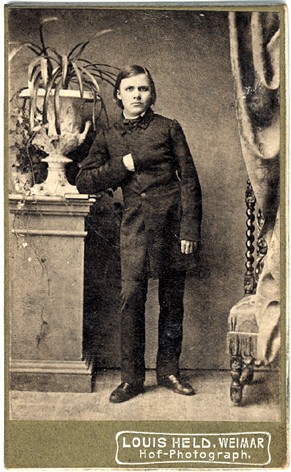
In Schulpforta, Nietzsche received an important literary education, especially in the study of Greek and Roman classics, and first experienced the lack of family life in a small town Christian environment. During this period he was under the influence of the poet Ernst Ortlepp.

After graduation in 1864, Nietzsche commenced studies in theology and classical philology at the University of Bonn. For a brief period he was a member of the Burschenschaft Frankonia next to Deussen. To the chagrin of his mother, he dropped out after a semester of theology and began those of philology with Professor Friedrich Wilhelm Ritschl. The following year he went to the teacher to the University of Leipzig.

In 1867 he did a year of voluntary service with the Prussian artillery division in Naumburg. In March 1868 he suffered an equestrian accident excluded him from military service and allowed to return to devote himself to study. That same year he met Richard Wagner, a key figure in its development.
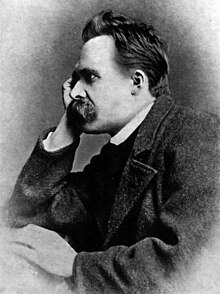
Thanks to Ritschl, Nietzsche received an extraordinary offer from the University of Basel to work as professor of classical philology before graduation, becoming the youngest college professor. In his philological work during that time it is worth noting that the discovery of rhythm in poetic meter ancient depended solely on the length of syllables unlike metric based on modern accentuation
.
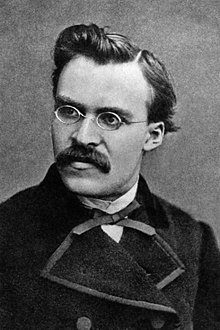
In 1869 the University of Leipzig awarded him a doctorate without examination or dissertation in recognition of the quality of their research. Immediately the University of Basel appointed professor of classical philology and the following year was promoted to honorary professor.

After moving to Basel, Nietzsche renounced his German citizenship, staying for the rest of her life officially without nationality. However in August 1870 he obtained a permit to serve in the Prussian side during the Franco-Prussian War but only as an orderly doctor as neutral Switzerland prevented him recruited as combatants. Its passage by the militia was only a month, but lived many experiences. There he witnessed the traumatic effects of battle. Contracted diphtheria and dysentery, diseases that ruined the lifelong health.

He was a philosopher, poet, musician and German philologist, considered one of most influential contemporary thinkers of the nineteenth century.

It conducted a thorough critique of culture, religion and Western philosophy, through the genealogy of concepts within each, based on the analysis of the (positive and negative) moral attitudes toward work life.This profoundly affected subsequent generations of theologians, anthropologists, philosophers, sociologists, psychologists, political scientists, historians, poets, novelists and playwrights.

He thought about the consequences of the triumph of secularism of the Enlightenment, expressed in his remark "Dios is dead" in a way that determined the agenda of many of the most famous intellectuals after his death.

Nietzsche received wide recognition in the second half of the twentieth century as a significant figure in modern philosophy. His influence was particularly noticeable in the existentialist philosophers, critics, phenomenological, poststructuralist and postmodernist, and sociology of Max Weber. It is considered one of the three "masters of suspicion" (in the celebrated words of Paul Ricoeur), along with Karl Marx and Sigmund Freud.

With the publication of Human, All Too Human in 1878, a book of aphorisms on multiple topics, from metaphysics to morality and religion to sex, distance of about Nietzsche's philosophy of Wagner and Schopenhauer became evident. His friendship with Deussen and Rohde cooled.
During his early years in Basel the ambivalent friendship of Nietzsche with Wagner cooked, and took every opportunity to visit Richard and his wife Cosima. Nietzsche appreciated Wagner as a brilliant professor apostle, but the exploitation of ever increasing Christian artistic motifs along with their chauvinism and anti-Semitism exceed what Nietzsche could bear.
The composition of Parsifal, Wagner conceive more like a liturgical car for Good Friday as an opera, deeply offended the sensitivity of Nietzsche. Although the gigantic work would not be released until 1882, and in 1878 the gap between the two would be inevitable and definitive.

Driven by his illness to find more temperate climates, Nietzsche traveled frequently and lived until 1889 as an independent author in different cities. He spent many summers in Sils Maria, near St. Moritz in the Engadine (Switzerland eastern end), and many autumns in the Italian cities of Genoa, Rapallo and Turin and the French city of Nice. Occasionally he returned to Naumburg to visit his family, and especially during this period, he and his sister had repeated episodes of conflict and reconciliation. He lived on his pension of retired professor of the University of Basel, but also received aid from friends.
Nietzsche was in the beginning of his most productive period. From Human, All Too Human in 1878, Nietzsche would publish a book (or mostly) a year until 1888, his last year of writing, during which he completed five. In 1879, Nietzsche published mixed opinions and maxims, which suggested the aphorism of Human, All Too Human.

In 1881 Nietzsche publishes Aurora. Reflections on moral prejudices, and in 1882 the first part of The Gay Science. This year he also met Lou Andreas-Salome through Malwida von Meysenbug and Paul Ree. Nietzsche and Salomé were the summer together in Tautenburg, often with Nietzsche's sister, Elisabeth. However, the view that Nietzsche had Salomé was more that of a friend and fellow discussions full of genius, than a potential partner. He loved her which caused an ambiguous and uncomfortable situation between the three friends, because Rée in turn was interested in Lou. When Nietzsche asked her to marry him, Salomé refused. Nietzsche's relations with Salome and Ree were broken in the fall of 1882-1883, partly because of intrigues conducted by his sister Elisabeth.

In the process of occurrence of new symptoms of his illness, isolated after discussions with his sister and mother, and plagued by suicidal thoughts, he moved to Rapallo, where in just ten days, anticipated by eighteen months of incubation, wrote the first part of Thus Spoke Zarathustra.

In 1886, he released Beyond Good and Evil. With this book and the emergence between 1886 and 1887 of second editions of his earlier works (The Birth of Tragedy, Human, All Too Human and The Gay Science), saw completed its work and esperanzó with a wave of readers appreciate his writings. In fact, interest in Nietzsche increased at this time, although this was hardly perceived by him.

Nietzsche continued to have frequent bouts of illness, making it impossible for her continuous work. In 1887, Nietzsche quickly wrote his controversial Genealogy of Morals. Also he exchanged letters with Hippolyte Taine, and then also with Georg Brandes, who at the beginning of 1888 developed in Copenhagen the first public reading of Nietzsche's philosophical work and study.
In the same year, Nietzsche wrote five books based on his voluminous notes, the result of long continuous work, which at first thought gather under the title The Will to Power. His health seemed to improve, and that summer was in good spirits. But by late 1888, his writings and letters began to reveal a pathological overestimation of their status and fate. He overestimated the increasing response to his writings, especially the recent controversy over Wagner's case.

On January 3, 1889 Nietzsche suffered a mental collapse. That day he was arrested after apparently have caused some form of public disorder, through the streets of Turin. What exactly happened is unknown. The extended version of what happened said that Nietzsche walked by the Piazza Carlo Alberto, when a sudden uproar that caused a driver to punish his horse caught his attention. Nietzsche ran to him and threw his arms around the horse's neck to protect it, vanishing into the ground immediately afterwards. In the following days, he wrote short letters to some friends, including Cosima Wagner and Jacob Burckhardt, which showed signs of dementia and megalomania.

By this time, Nietzsche was entirely submerged in madness, and his mother Franziska decided to take him to a clinic in Jena under the direction of Otto Binswanger. From November 1889 to February 1890, Julius Langben tried to cure Nietzsche, sentencing Dr. methods were ineffective to cure their condition. Langbehn assumed more and more control over Nietzsche. In March 1890, Franziska removed Nietzsche from the clinic, and in May 1890 led to his home in Naumburg.

In 1893, Elisabeth Nietzsche returned from Paraguay in May after the suicide of her husband. She read and studied Nietzsche's works, and piece by piece took control of them and their publication. Overbeck gradually ostracized, and Gast finally cooperated. After the death of Franziska in 1897, Nietzsche lived in Weimar, where he was cared for by Elisabeth, who allowed people to visit her uncommunicative brother. The August 25, 1900, Nietzsche died after contracting pneumonia. By desire of Elisabeth, he was buried beside his father in the church of Röcken.

